- Enseignant: amiraachouak oulha

- Enseignant: amiraachouak oulha
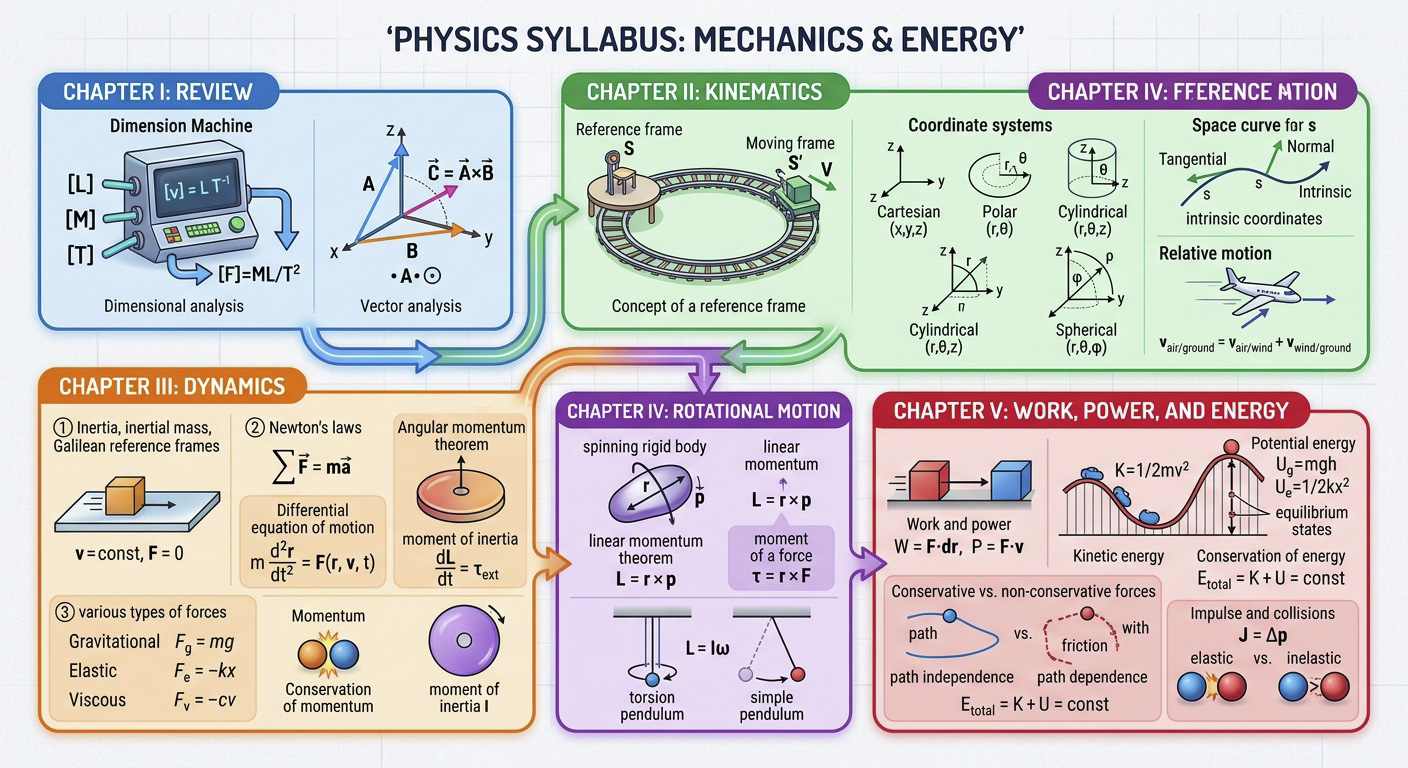
This course delves into key concepts such as kinematics, dynamics, rotational motion, work, energy, and conservation laws.
We begin by examining kinematics, the branch of mechanics concerned with the description of motion. Through the analysis of position, velocity, and acceleration, we gain insight into how material points move through space and time. Dynamics, on the other hand, focuses on the forces that cause these motions. Newton's laws of motion serve as the backbone of this study, providing a framework to understand the relationship between force, mass, and acceleration.
A central theme in this subject is the concept of work and energy. We explore how work, defined as the transfer of energy via force over a distance, can change a material point's kinetic and potential energy. The work-energy theorem connects these concepts, revealing how forces affect the motion and energy states of objects. This leads to the examination of kinetic energy, associated with motion, and potential energy, linked to an object's position within force fields.
One of the most powerful principles we investigate is the conservation of mechanical energy. In scenarios where only conservative forces are at play, the total mechanical energy of a system remains constant, simplifying complex problems and enabling predictions about the behaviour of material points in gravitational fields, spring systems, and other contexts.
Throughout this subject, students develop problem-solving skills and gain a deep understanding of the laws governing the motion of material points. This knowledge forms the basis for more advanced studies in mechanics, as well as applications in fields such as engineering, physics, and astronomy. Ultimately, the mechanics of a material point serves as a cornerstone for comprehending the intricacies of the physical universe.
- Enseignant: Nadjima Benkara Mohammed
- Enseignant: asma bouarissa