
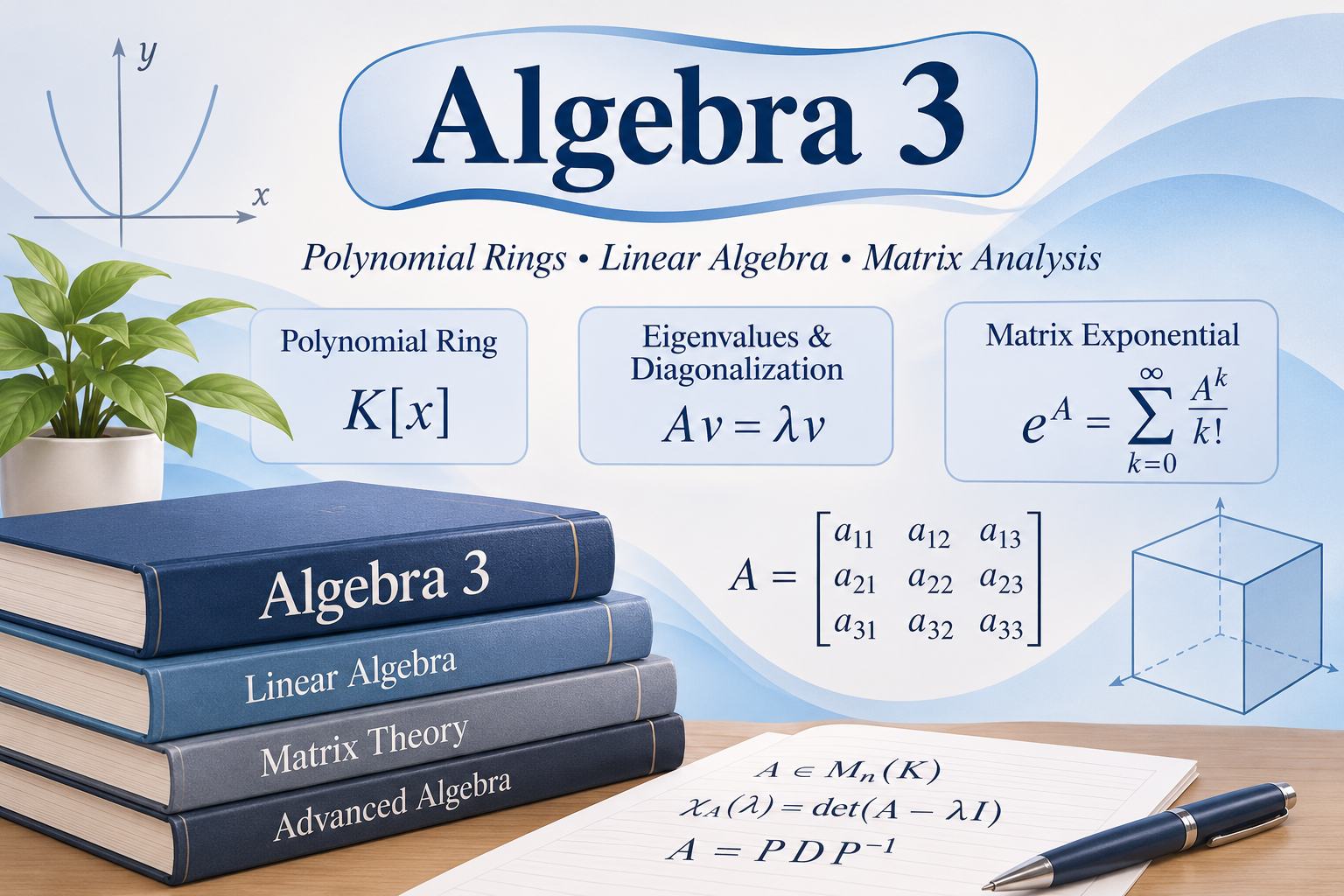
This course introduces the fundamental concepts of Algebra 3 for second-year undergraduate students in Mathematics. It covers polynomial rings, groups, rings and ideals, the reduction of endomorphisms, eigenvalues and eigenvectors, diagonalization, triangularization, and Jordan forms. The course also studies matrix exponentials and their applications to solving linear differential systems with constant coefficients.
- Enseignant: Asma Maadadi

LaTeX, is free software used to create high-quality documents, especially scientific and technical documents.
It separates the content from the document formatting.This helps users create structured, clear, and professional documents.
This course is designed for Licence 2 Mathematics students
- Enseignant: anissa ticherahine
Advanced Scientific Computing with Python focuses on tools such as NumPy, SciPy, Matplotlib, SymPy, and Pandas to solve mathematical problems, perform numerical computations, analyze data, and create scientific visualizations.
It aims to develop students’ programming skills and their ability to apply computational methods to mathematical and scientific problems.
This course is designed for second-year undergraduate students in Mathematics.
- Enseignant: anissa ticherahine
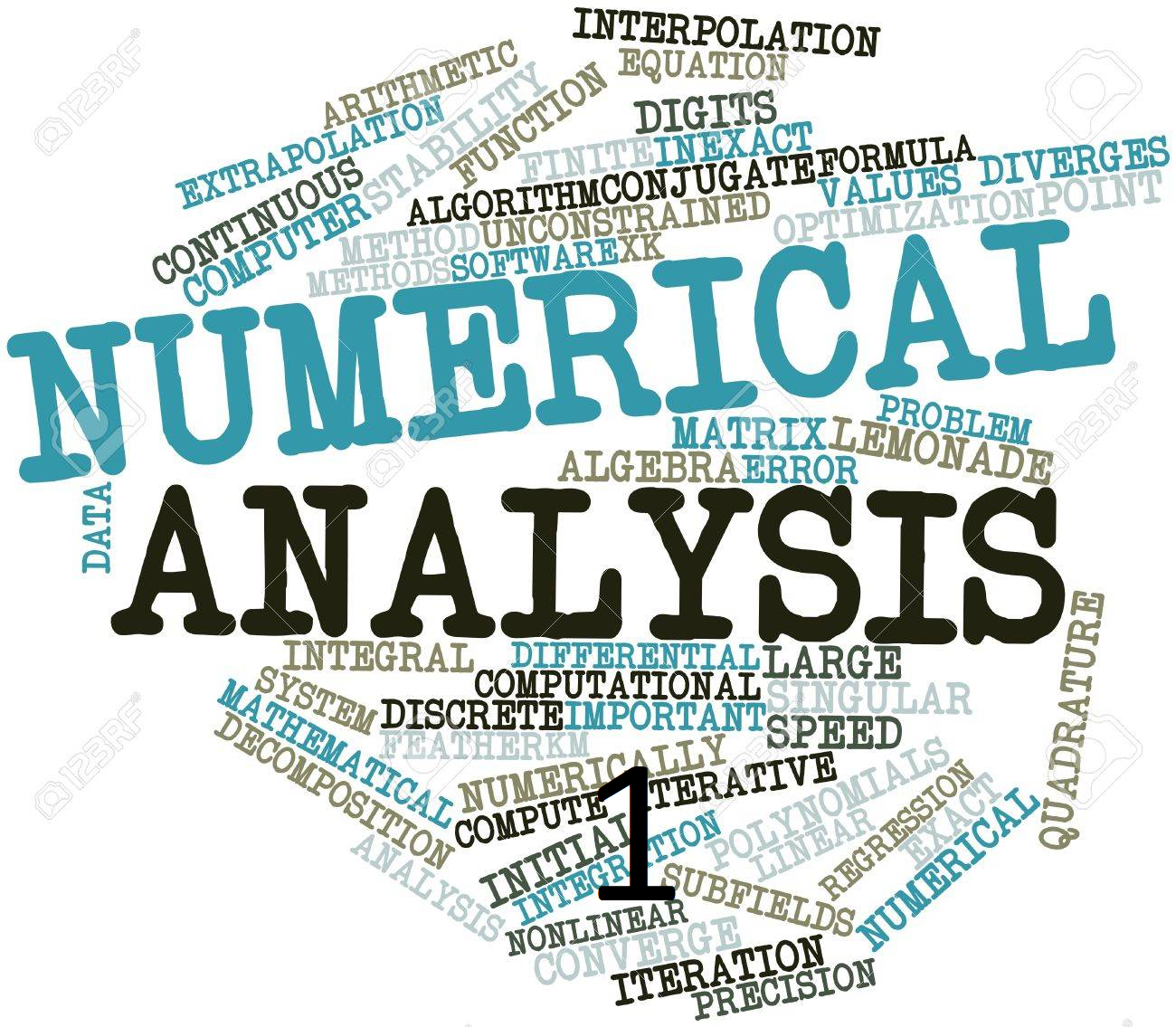
This course introduces the basic concepts and methods of Numerical Analysis. It is designed for second-year undergraduate students in Mathematics.
The course covers five main topics: error analysis, solving nonlinear equations, interpolation and approximation, numerical differentiation, and numerical integration.
Students will learn how to find approximate solutions to mathematical problems. They will also study the accuracy and convergence of numerical methods.
The practical sessions will use Python programming. Students will learn how to implement numerical methods and apply them to solve mathematical problems.
- Enseignant: Asma Maadadi
Mathematical Logic is a branch of mathematics that focuses on the principles of logical reasoning and rigorous mathematical argumentation. It provides a formal framework for expressing mathematical statements, analyzing their truth, and establishing the validity of mathematical arguments and proofs.
- Enseignant: khadra dekkar
- Enseignant: rebiha zeghdane
Contenu et objectif de la matière:
Les fondements du calcul propositionnel et du calcul des prédicats.
Principes de bases de rédaction d'une preuve mathématique. Aquérir les fondements de la théorie des ensmbles.
- Enseignant: ikram guidoum
Introduction pour MATLAB
- Enseignant: abdelouahab mani
- Enseignant: Asma Maadadi
- Enseignant: ahmed guechi
الأعمال الموجهة في تاريخ الرياضيات هي عبارة عن أعمال يجب على الطالب في السنة الثانية رياضيات أن ينجزها بناء على مراجع تمكنه من ذلك، وهي تخل في تقييمه من جهة ، وكذا زيادة معارفه العلمية بتاريخ الرياضيات
- Enseignant: amar benazouaou
cours et TD
- Enseignant: abdelouahab mani
تاريخ الرياضيات مقياس يدخل في إطار المقرر الدارسي لطلبة السنة الثانية ليسانس رياضيات، وهو يتضمن التعرف على المسار الكرونولوجي لهذا العلم ، بداية من الحضارات الشرقية القديمة وإلى غاية اللحظة الراهنة، وهو مقياس مهم ذلك لانه من الناحية البيداغوجية من غير المنطق لدارس الرياضيات أن يدرس هذه الأخيرة كعلم ولا يتعرف على ممونها التاريخي
- Enseignant: amar benazouaou
- Enseignant: firouz belmechri
- Enseignant: ahmed guechi
Le but de cette matière est d’acquérir les éléments fondamentaux de l'algèbre à savoir les espaces vectoriels et réduction des endomorphismes d'espaces vectoriels de dimension finie. Connaissances préalables recommandées : Algèbre de base (Algèbre 1,2).
- Enseignant: hassene bouremel
- Enseignant: Bilal Ghermoul