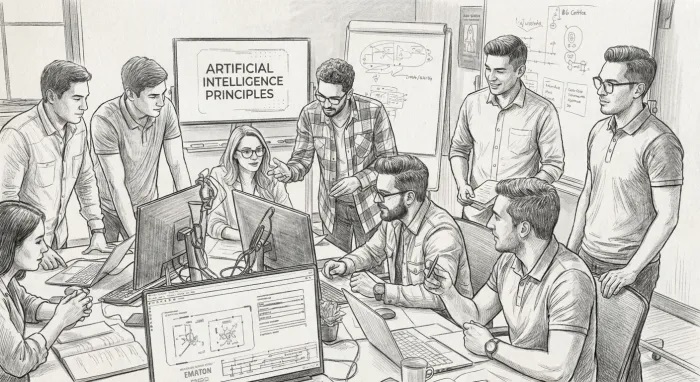
L'objectif de ce cours est l'acquisition of fundamental and preliminary notions about AI.
- المعلم: mourad nouioua
- المعلم: Bilal SAOUD
Section 1 : Discrete signals / Signaux Discrets, Section 2 : Audible signals / Signaux sonores audibles,
Section 3 : Audio Mixing / Mixage Audio, Section 4 : Discrete Systems / Systèmes discrets,
Section 5 : Time-based filtering / Filtrage temporel, Section 6 : Fourier Series / Les Séries de Fourier,
Section 7 : Discrete Fourier Transform and Fast Fourier Transform (FFT), Section 8 : Frequential filtering / Filtrage fréquentie, Section 9 : Short time Fourier transform (STFT) and Waveletsp,
- المعلم: messaoud mostefai

Cloud computing is a technology that enables the delivery of computing resources—such as servers, storage, databases, networking, software, and processing power—over the Internet, rather than through local servers or personal computers. These resources are provided on demand, allowing users to access and use them whenever needed without having to own, install, or maintain physical infrastructure.
Cloud computing is based on the principle of resource sharing and virtualization, where large data centers host pooled resources that can be dynamically allocated to multiple users. This approach offers scalability, meaning resources can be increased or decreased quickly according to workload demands, and cost efficiency, as users typically pay only for the resources they consume.
The cloud also promotes flexibility and accessibility, enabling users to access applications and data from anywhere with an Internet connection. It supports various service models—such as Infrastructure as a Service (IaaS), Platform as a Service (PaaS), and Software as a Service (SaaS)—and can be deployed in different ways, including public, private, hybrid, and community clouds.
Overall, cloud computing simplifies IT management, accelerates innovation, and provides reliable, scalable, and cost-effective computing solutions for individuals, businesses, and institutions.
- المعلم: Mira Lefkir